

Anxiety has a way of creeping into ordinary days and turning them upside down. A racing heart before a big decision, a sleepless night spent replaying worries, a tight chest when the bills pile up. Many of us know this feeling far too well. The good news is that God never intended for His children to carry these burdens alone.
This article looks at what the Bible teaches about anxiety, offers prayers you can use right now, and shares practical habits that bring lasting peace. Whether you are facing a stressful season or simply want to grow closer to God in your daily walk, this guide is written to help you find rest for your soul.
What Does the Bible Say About Anxiety?
Scripture speaks directly and often about anxiety, fear, and worry. God does not shame us for feeling anxious. Instead, He meets us in that place and offers a different way to live. The Bible gives both a command and an invitation: stop fearing, and start trusting. These two ideas work together to form the foundation of a peaceful heart.
God’s Command Not to Fear
Throughout Scripture, God repeats the phrase “do not be afraid” more than any other command. This is not a casual suggestion. It is a loving instruction from a Father who knows His children struggle with fear on a regular basis. He understands that fear is one of the most common human experiences, and He addresses it directly rather than leaving us to figure it out alone.
When God tells us not to fear, He always pairs it with a reason to trust Him. He reminds His people that He is with them, that He goes before them, and that He has already secured their future. This pattern shows up from Genesis through Revelation. Learning to recognize this command as an act of love, rather than a rule to follow, changes the way anxious thoughts are received and processed.
Trusting God With Your Worries

Trust is not something that happens automatically. It is built over time through small decisions to hand over control. The Bible encourages believers to bring every worry to God rather than carrying it silently. This act of surrender is not weakness. It is one of the most courageous things a person can do, because it requires letting go of the illusion that we can manage everything on our own.
Philippians 4:6-7 captures this beautifully, encouraging believers to present their requests to God with thanksgiving rather than letting worry take over. The promise attached to this verse is powerful. When worries are exchanged for prayer, God offers a peace that goes beyond human understanding. If you want to dive deeper into this, our guide on how to find peace of mind through prayer offers more ways to quiet an anxious heart. This peace does not always remove the problem, but it changes how the problem feels.
Powerful Prayer for Anxiety and Stress Relief
Prayer is one of the most direct ways to address anxiety in the moment it strikes. Speaking honestly to God, without polished language or perfect words, opens the door for His peace to enter. Below are two prayers written for different needs: one for a racing mind and one for a wounded heart. Both can be prayed silently, aloud, or written down in a journal.
Prayer for a Calm Mind
Heavenly Father, my thoughts feel scattered and heavy today. I cannot seem to quiet the worry running through my mind, and I need Your help to find stillness. Please calm the noise inside me and replace it with Your peace. Help me remember that You are in control even when my thoughts try to convince me otherwise.
Lord, I ask You to guard my mind against the lies that anxiety tells me. Remind me that I do not have to solve every problem tonight or carry tomorrow’s weight today. Give me the grace to rest in this moment, trusting that You are already working on my behalf. Thank You for being a God who cares about my mental and emotional health, not just my circumstances.
Prayer for Emotional Healing
Father, my heart feels worn down from carrying this stress for so long. I bring You the hurt, the exhaustion, and the fear I have been holding onto. I ask for Your healing touch on the parts of me that feel broken or overwhelmed. You see what I am going through, even the parts I have not spoken aloud. If you are also carrying physical strain alongside emotional weight, this prayer for emotional and physical healing can offer additional comfort.
Help me release the pain I have been holding instead of letting it pile up inside me. Teach me to lean on You during the hardest moments rather than pretending everything is fine. I trust that You are restoring me, even in ways I cannot yet see or feel. Thank You for never giving up on me, even when anxiety makes me feel distant from You.
Common Causes of Anxiety and Stress
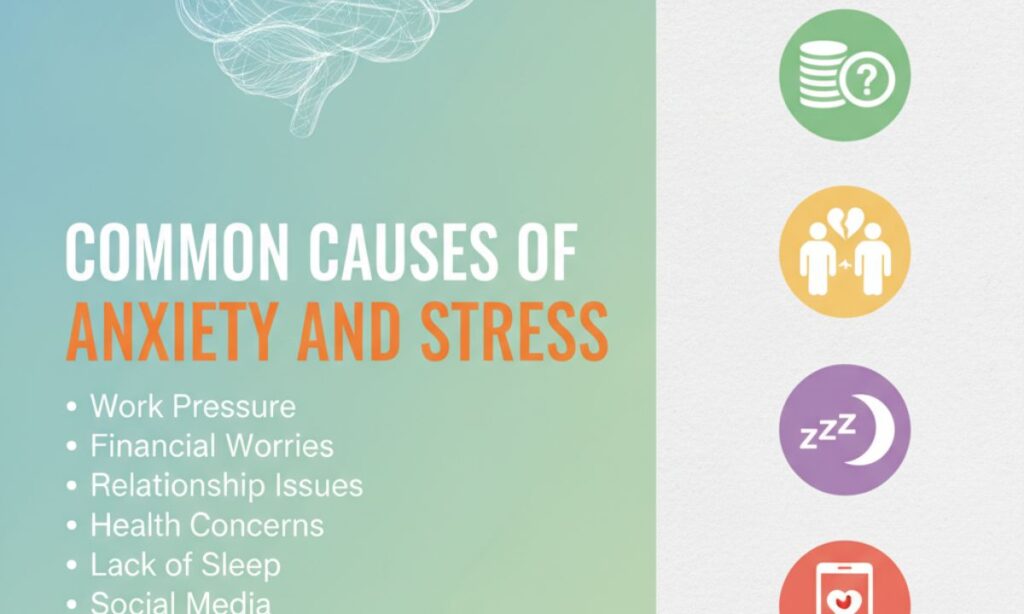
Anxiety rarely appears out of nowhere. It usually has a source, and identifying that source is an important step toward finding relief. While every person’s experience is unique, certain stressors tend to affect believers and non-believers alike. Recognizing these patterns helps in praying more specifically and seeking practical solutions alongside spiritual ones.
Financial Worries
Money concerns are among the most common triggers for anxiety. Unexpected bills, job instability, or the pressure of providing for a family can create a constant undercurrent of stress. This type of worry often follows people throughout the day, showing up during work, family time, and even sleep. It can feel relentless because money touches nearly every part of daily life.
The Bible addresses financial anxiety directly, reminding believers that God provides for even the smallest creatures and will not forget His own children. This does not mean financial struggles disappear overnight. It means there is a foundation of trust to stand on while working through practical steps like budgeting, seeking wise counsel, or asking for help. Prayer combined with responsible action tends to bring the most lasting relief in this area.
Relationship Problems
Conflict with a spouse, tension with family members, or the pain of a broken friendship can create deep emotional stress. Relationships matter to the human heart, and when they suffer, anxiety often follows close behind. Unlike financial stress, relationship anxiety can feel more personal and harder to talk about openly.
Scripture encourages believers to pursue peace and seek reconciliation whenever possible, while also reminding them that not every relationship will be repaired. Praying for wisdom in difficult relationships, along with the strength to forgive, often brings a measure of peace even when the relationship itself remains unresolved. God’s presence in these moments offers comfort that does not depend on the other person changing.
Bible Verses to Overcome Anxiety

Scripture provides specific verses that speak directly to fear, worry, and the search for peace. Memorizing or writing down these verses gives the mind something true to return to when anxious thoughts rise. Below are verses grouped by theme: peace and hope.
Scriptures About Peace
Philippians 4:6-7 remains one of the most quoted passages on anxiety, encouraging believers to pray rather than worry and promising a peace beyond understanding in return. John 14:27 records Jesus telling His disciples that He leaves them with peace, a peace unlike anything the world can offer, urging them not to be troubled or afraid.
Isaiah 26:3 promises perfect peace for those whose minds stay fixed on God, connecting steady trust with steady peace. These verses are not abstract ideas. They describe a real, tangible calm that settles over a person who chooses to focus on God rather than their circumstances. Reading them slowly, rather than rushing through, allows their truth to sink deeper into an anxious heart.
Scriptures About Hope
Romans 15:13 describes God as the source of all hope, asking that believers be filled with joy and peace as they trust in Him, so their hope overflows through the Holy Spirit’s power. This verse ties hope directly to trust, showing that hope grows stronger the more a person leans on God rather than their own understanding.
Jeremiah 29:11 reminds believers that God has plans for their welfare, not for harm, plans that include a future filled with hope. This verse is especially comforting during uncertain seasons, when the future feels unclear or frightening. Holding onto these promises does not erase present difficulties, but it gives the heart something solid to stand on while waiting for things to improve.
How Prayer Helps Reduce Stress
Prayer is more than a religious habit. It has a real, measurable effect on the mind and body when practiced consistently. Talking to God shifts focus away from the problem and toward the One who can handle it. This section explores three specific ways prayer reduces stress and brings lasting change to a worried heart.
Replacing Fear With Faith
Fear and faith cannot occupy the same space for long. When a person prays consistently, they are training their mind to respond to stress with trust instead of panic. This is not an instant transformation, but a gradual shift that happens through repeated practice. Each time a worry is brought to God instead of left to spiral, faith grows a little stronger.
Over time, this practice changes the default reaction to stressful situations. Instead of immediately spiraling into worst-case scenarios, a person who prays regularly begins to pause and ask what God might be doing in the situation. This shift does not mean problems disappear. It means the response to problems becomes steadier and less reactive.
Finding Comfort in God’s Presence
One of the most powerful aspects of prayer is the reminder that no one faces anxiety alone. God’s presence offers comfort that human words often cannot provide. Simply sitting quietly and acknowledging that God is near can lower the intensity of anxious feelings, even before any specific request is made.
This sense of presence is especially helpful during sleepless nights or moments of sudden panic. Praying short phrases like “You are here with me” or “I am not alone” can interrupt a spiral of anxious thoughts. Many people find that this simple practice, repeated consistently, becomes a reliable tool for managing stress the moment it strikes.
Building Emotional Resilience
Prayer also builds long-term resilience, making it easier to handle future stress when it arises. Each time a person works through anxiety with prayer, they are strengthening their ability to cope with hardship. This resilience does not come from avoiding difficulty but from facing it repeatedly with God’s help.
Over months and years, this consistent practice creates a kind of emotional muscle memory. The mind learns that stressful situations, while uncomfortable, are survivable and even manageable with God’s support. This does not mean anxiety disappears completely, but it becomes less overwhelming and easier to navigate each time it appears.
Daily Habits for Managing Anxiety
Prayer works best when paired with consistent daily habits that reinforce a peaceful mindset. Anxiety often thrives on neglect, growing stronger when ignored and weaker when addressed regularly. The following habits are simple enough to maintain even during busy or difficult seasons.
Reading the Bible Daily
Setting aside even ten minutes a day to read Scripture gives the mind a steady source of truth to return to throughout the day. Anxiety often feeds on uncertainty, and the Bible offers something certain to hold onto. Choosing a specific time, such as first thing in the morning or right before bed, helps turn this into a consistent habit rather than an occasional activity.
Many people find it helpful to focus on a single verse or short passage rather than trying to read large sections at once. Slowing down allows the words to be absorbed rather than skimmed. Writing down a verse that stands out, or saying it aloud a few times, helps it stay accessible during stressful moments later in the day.
Keeping a Prayer Journal
Writing down prayers, worries, and answered prayers creates a visual record of God’s faithfulness over time. This habit is particularly helpful for anxious minds because it externalizes worry instead of letting it loop endlessly inside the head. Seeing a worry written on paper often makes it feel more manageable than when it is only spinning silently in the mind.
A prayer journal also becomes a powerful tool during future struggles. Looking back at past entries and seeing how previous worries were resolved builds confidence that current struggles will also pass. This habit does not need to be lengthy or polished. Even a few honest sentences each day are enough to create a meaningful record over time.
How to Trust God During Difficult Seasons
Every life includes seasons that feel uncertain, painful, or simply too heavy to carry. Learning to trust God during these times is different from trusting Him when life feels easy. It requires a deeper, more deliberate choice to believe He is good even when circumstances suggest otherwise.
Letting Go of Fear
Letting go of fear does not mean pretending it does not exist. It means acknowledging the fear honestly and then choosing, again and again, to hand it over to God instead of carrying it alone. This is rarely a one-time decision. It is a daily, sometimes hourly, practice of releasing control.
Many people find it helpful to physically express this release, such as writing the fear on paper and praying over it, or speaking it aloud before going to sleep. These small actions create a sense of closure, even temporarily, and remind the heart that it does not have to hold everything alone. Over time, this repeated practice makes letting go feel less like a struggle and more like a natural response.
Waiting on God’s Perfect Timing
Waiting is one of the hardest parts of trusting God, especially during anxious seasons when answers feel urgent and necessary right away. God’s timing rarely matches human expectations, and this mismatch often fuels additional stress. Learning to wait well does not mean waiting passively. It means continuing to pray, act wisely, and trust while the answer is still unfolding. Many people find strength during these waiting seasons through seeking God’s guidance, which helps bring clarity even when the path ahead is unclear.
Isaiah 40:31 promises renewed strength for those who wait on the Lord, comparing their endurance to eagles soaring without growing weary. This image offers a helpful reframe. Waiting is not wasted time. It is an active season of growth, even when nothing visible seems to be happening. Trusting God’s timing, rather than demanding an immediate resolution, often brings unexpected peace in the middle of the wait.
Frequently Asked Questions
Does Prayer Help With Stress?
Yes, prayer has a genuine calming effect on stress. Speaking honestly to God shifts focus away from the problem and toward a source of comfort and control beyond ourselves. Many people report feeling physically calmer after praying, even when their circumstances have not yet changed. Consistent prayer also builds long-term resilience, making future stress easier to manage.
Can Christians Struggle With Anxiety?
Yes, Christians can and often do struggle with anxiety. Faith does not make a person immune to stress, fear, or worry. The Bible itself shows many faithful figures, including David and Elijah, wrestling with fear and discouragement. Struggling with anxiety is not a sign of weak faith. It is a normal human experience that God addresses with compassion rather than judgment.
What Is the Best Bible Verse for Anxiety?
Philippians 4:6-7 is widely considered one of the most helpful verses for anxiety, as it offers both a clear instruction and a specific promise. The verse encourages believers to bring their worries to God through prayer and thanksgiving, with the promise that His peace will guard their hearts and minds in return. Many people memorize this verse specifically to recall during anxious moments.
How Often Should I Pray for Anxiety Relief?
There is no required frequency, but praying consistently, even briefly, tends to be more effective than occasional long prayers. Many people find it helpful to pray short phrases throughout the day whenever anxious thoughts arise, in addition to a longer, more focused prayer time each morning or evening. The goal is a steady connection with God rather than a perfect routine.
Can Anxiety Be a Sign of Spiritual Attack?
Anxiety can sometimes be connected to spiritual struggles, but it is also frequently rooted in biological, emotional, or circumstantial factors. The Bible encourages believers to take every thought captive and resist fear, which can include spiritual resistance through prayer and Scripture. At the same time, seeking medical or professional support for anxiety is wise and does not contradict faith. God often works through both spiritual practices and practical care.
Conclusion
Anxiety and stress are part of the human experience, but they do not have to control daily life. Through prayer, Scripture, and consistent daily habits, it is possible to find real and lasting peace even in difficult seasons. God does not ask believers to pretend their worries do not exist. He invites them to bring those worries honestly to Him, trusting that He cares deeply about every burden carried.
If anxiety feels overwhelming today, consider starting small. Pray one honest sentence, read one verse, or write one worry down on paper. These small steps build toward a deeper trust over time. God’s peace is available right now, ready to guard your heart and mind as you continue walking through whatever season you are facing.

With over 4 years of experience in writing and sharing faith-based content, this author is passionate about helping others grow through prayer and the teachings of the Bible. They are dedicated to creating inspiring devotionals and meaningful reflections that guide readers in their daily walk with God.

4 thoughts on “Prayer for Anxiety and Stress Relief Through God’s Peace”